



The Opportunity
FitLovas is a women's strength training studio chain in Barcelona, now running three studios across two booking-platform accounts. The growth work was already bringing in members. The operation behind it had not kept pace.
Every new member touched five or six systems: the landing page, a payment provider, a sign-up form, the booking platform, a CRM, a WhatsApp inbox and the ad platform. None of them talked to each other. The booking platform's own checkout ran to around eight screens and thirteen fields. Front desk staff re-keyed details by hand, set up direct debits one at a time, and found out a payment had failed when a member was already standing at reception.
The brief was to make the business run on its own systems, so that opening a fourth studio would add members rather than administration.
The Solution
One sign-up path, end to end
We replaced the booking platform's checkout with a single form per offer, fed by landing pages we built and host. The moment someone signs up, the new member appears in the booking system under the right studio, on the right plan, with their bank details checked and their monthly payment set up. Any joining fee or trial is recorded too. Introductory offers move to full price on their own after three months, so nobody has to remember to change it.
Staff selling at the desk use the same path through an internal sign-up page, so a walk-in member and an online one produce identical records.
Closing the gaps the platforms leave open
Not every step is available through a public API. Where the booking platform could not set the chargeable bank account programmatically, we built a scheduled job that completes it, then moved the step forward so the direct debit is in place at sign-up rather than hours later. A read-back of the stored account confirms the write before the record is marked done.
Attribution the ad platform can learn from
Each ad click is carried from the landing page through the form and stored against the member. When a lead, a trial or a membership is created, in the form or directly in the booking platform by staff, a server-side event goes to Meta with the same identifiers the browser pixel used, so conversions are counted once and credited to the campaign that earned them.
Messaging that knows who it is talking to
New members are relayed to the email CRM and to the WhatsApp platform the moment their contract exists. When someone new writes in on WhatsApp, their number is looked up across both booking accounts, and the conversation is tagged with their studio and whether they are already a member, so it lands in the right inbox with context.
A system that checks its own work
Every morning a reconciliation compares the sign-up forms against the booking platform and replays anything that did not arrive, using the same code the live webhook runs. A second report compares every bank account on file against what the booking platform will charge and re-queues any that fell through. Both post to the team's Slack in plain Spanish, with a clear flag when a check could not run. Staff are told when a member is on the wrong plan, when a sign-up needs a manual step, and when a connected system has rejected its credentials.
Helios, the central data layer
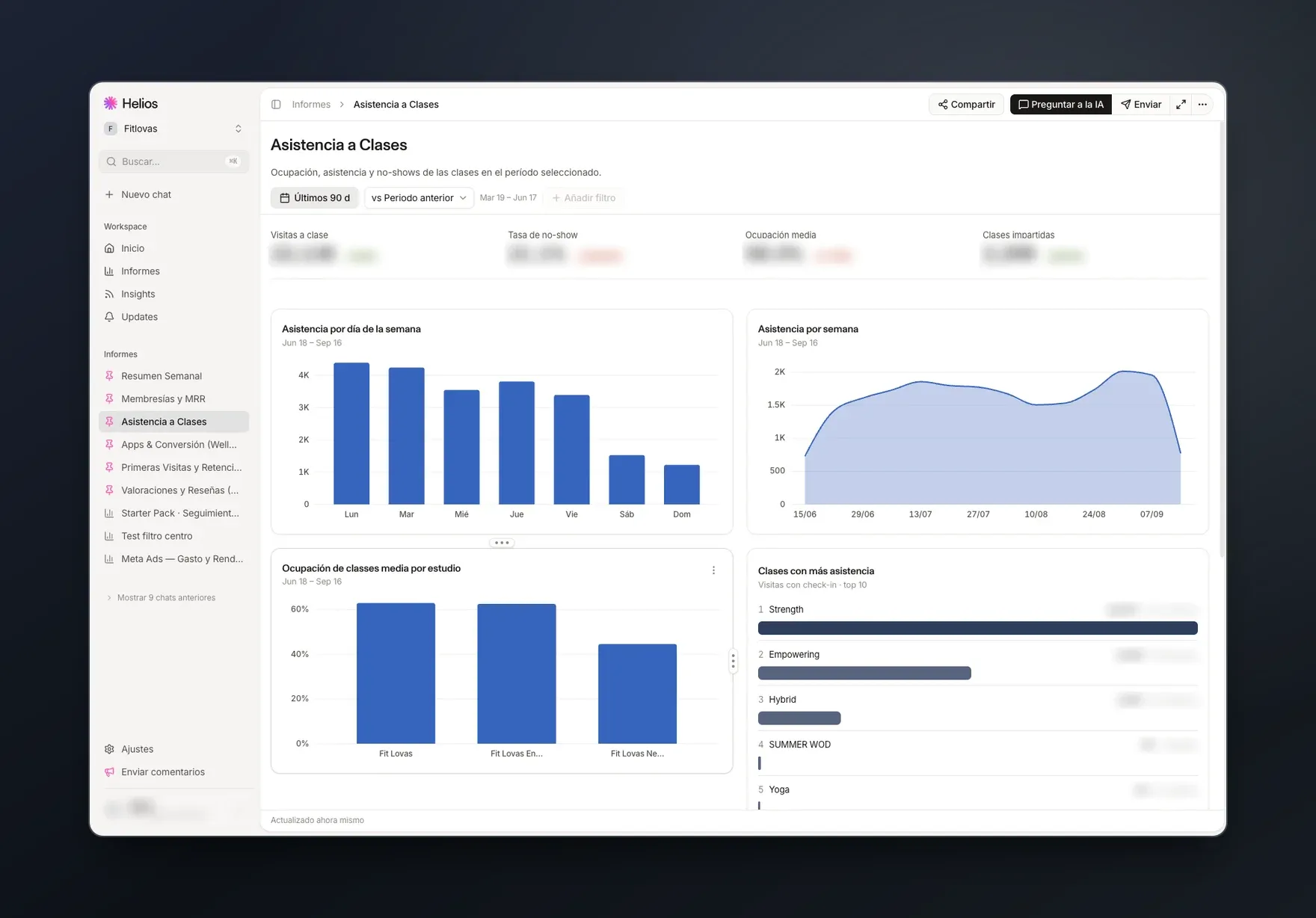
Underpinning the entire setup is Helios, our AI analytics platform, where every number the business runs on is consolidated. Bookings, attendance and memberships flow in from the booking system, spend and results from the ad accounts, and ratings from the studio reviews, all without anyone exporting a file. Managers ask questions in plain Spanish and get answers from live data, saved reports cover the weekly summary, memberships and recurring revenue, attendance, first visits and retention, and insights flag what needs attention. Helios is the quiet link that keeps the front desk, the managers and our media team working from the same, accurate numbers.
The Impact
Sign-ups that complete themselves. A new member goes from the landing page to an active contract, a direct debit, a CRM record and an ad conversion without anyone at the studio touching a keyboard. The desk spends its time with members.
Failures surface before a member does. Missing sign-ups are replayed overnight, unchargeable accounts are caught in the morning report, and the team hears about a broken credential in Slack rather than from an empty CRM a week later.
Built to be changed. The system has grown from one founding-membership page to three studios, trial packs, promotions and desk sales in four months, and more than five hundred automated tests describe how each part behaves. When the business changes an offer, the automation changes with it the same week.
The Engagement
We designed, built and run the whole layer: the landing pages, the sign-up and payment flows, the booking-platform integration and its daily safety nets, the server-side attribution, the CRM and WhatsApp relays, the staff alerts, and the internal admin and diagnostic tools that let us answer a question about any member in minutes.
It runs alongside the growth programme described in the companion case study, and Helios sits on top of both, so the numbers the team reads and the numbers we optimise against come from the same place.